┌──────────────────────────────────────────────────────────────┐
  RECORD TYPE ......... ANNOTATION — SOURCED RECORD
  REGISTRY NO. ........ MARG-0042
  SLUG ................ /gulf-of-tonkin-nsa-intercepts-august-4-1964
  STATUS .............. CLOSED
  FILED ............... 2026-06-10 18:44 UTC
  LAST ANNOTATED ...... 2026-06-10 18:44 UTC
  CLAIMS ON FILE ...... 8
  MEAN TAG CONFIDENCE . 0.92
└──────────────────────────────────────────────────────────────┘
Gulf of Tonkin Incident: NSA Declassified Intercepts and the August 4, 1964 Second Attack
SUMMARY
The Gulf of Tonkin incident of August 1964 is the historical trigger for expanded U.S. military involvement in Vietnam. The first engagement on August 2, 1964, between USS Maddox and North Vietnamese patrol boats is well-documented and uncontested. The second alleged attack on August 4, 1964, however, has been central to decades of debate regarding whether it actually occurred. For nearly 40 years, the U.S. government maintained that both attacks happened and used the August 4 incident as justification for the Tonkin Gulf Resolution and subsequent escalation. In 2005, the National Security Agency released declassified intelligence studies (Cryptologic Quarterly articles and formally classified NSA technical reports) that directly contradicted the official narrative. NSA historians analyzing the intercepted North Vietnamese radio communications—the primary intelligence asset available at the time—concluded that no credible evidence of a second attack existed in the intercepts. The declassified NSA materials, combined with testimony from officers aboard USS Turner Joy and investigative journalism, established that the August 4 incident likely never occurred. This case is now largely closed from an intelligence standpoint: the primary signal intercepts do not support a second attack, and no orders, tactical reports, or acknowledgments of such an attack appear in the released communications. What remains documented is a sequence of misinterpretation, ambiguous radar data, and institutional pressure that led political leaders to report an attack that the intelligence community's own signals evidence did not verify.
STRONGEST CASE FOR
Defenders of the official 1964 narrative argue that: (1) Radar signatures on USS Turner Joy on the night of August 4 appeared consistent with hostile craft; (2) sonar contact reports were made by ship operators under combat stress; (3) weather conditions and communication delays created genuine ambiguity in real time; (4) not all North Vietnamese radio traffic was intercepted—silence in the intercepts does not conclusively prove no attack occurred; (5) operational security protocols would have minimized NVN radio chatter about a second attack if one had been hastily mounted; (6) multiple credible personnel on scene reported hostile action, and their perception may reflect authentic tactical engagement even if the intercepts are silent. From this view, absence of signals evidence is not the same as evidence of absence.
STRONGEST CASE AGAINST
The NSA's own 2005 declassification (detailed in NSA Cryptologic Quarterly articles and the formal study on Skunks, Bogies, and Phantom Contacts) concludes that: (1) no intercepts from North Vietnamese sources show any tactical command, sitrep, or acknowledgment of a second attack; (2) the first attack on August 2 is clearly reflected in NVN intercepts, providing a baseline for comparison; (3) USS Turner Joy's radar and sonar data, upon later technical review, appear consistent with weather phenomena and false echoes in poor conditions; (4) the ship's captain and later investigators acknowledged the evidence was ambiguous; (5) declassified documents show political pressure to justify retaliatory action, and the reported attack became increasingly firm in official statements despite weak signals support; (6) no North Vietnamese participant—captured, defected, or speaking after the war—ever claimed or acknowledged launching a second attack. The intercepts are directly silent where they should be loudest, and that silence, combined with other evidence, strongly indicates no attack occurred.
CLAIMS
- VERIFIEDCONF 0.95
Declassified NSA intercepts of North Vietnamese radio communications from August 4, 1964, contain no evidence of orders, tactical reports, or acknowledgment of a second attack.
— attributed to: NSA Center for Cryptologic History, declassified 2005
- NSA Cryptologic Quarterly articles declassified in 2005 (https://www.nsa.gov/portals/75/documents/news-features/declassified-documents/gulf-of-tonkin/articles/release-1/rel1_skunks_bogies.pdf)
- NSA technical analysis of intercepted communications shows clear signals from first attack (Aug 2) but absence of equivalent signals from Aug 4 engagement
- GWU National Security Archive NSAEBB132 documentation (https://nsarchive2.gwu.edu/NSAEBB/NSAEBB132/tapes.htm)
- VERIFIEDCONF 0.98
The August 2, 1964 North Vietnamese attack on USS Maddox is corroborated by intercepted NVN radio traffic, tactical orders, and sitreps.
— attributed to: NSA declassified records and historical consensus
- NSA intercepts show NVN tactical coordination and acknowledgment of the August 2 engagement
- Multiple declassified government sources confirm first attack occurred (https://www.history.navy.mil/research/library/online-reading-room/title-list-alphabetically/t/tonkin-gulf-crisis/formerly-classified-documents-from-2-aug-4-aug-1964.html)
- Contemporary ship logs and after-action reports from USS Maddox
- CORROBORATEDCONF 0.90
USS Turner Joy and USS Maddox reported hostile contact via radar and sonar on the night of August 4, 1964.
— attributed to: U.S. Navy ship reports, August 4–5, 1964
- Original ship's logs and tactical reports declassified and held by U.S. Naval History Center (https://www.history.navy.mil/research/library/online-reading-room/title-list-alphabetically/t/tonkin-gulf-crisis/formerly-classified-documents-from-2-aug-4-aug-1964.html)
- Turner Joy captain later stated uncertainty about the engagement
- Edwin E. Moïse's scholarly treatment in 'Tonkin Gulf and the Escalation of the Vietnam War' (2019) documents ship-reported incidents
- CORROBORATEDCONF 0.85
Subsequent technical analysis suggests August 4 radar and sonar returns were likely false signals caused by weather, sea conditions, and equipment sensitivity rather than hostile craft.
— attributed to: NSA technical analysis and naval historians
- NSA declassified studies on signal analysis, 2005
- Naval Historical Center analysis of radar performance in adverse weather
- Edwin E. Moïse scholarly analysis (https://edmoise.sites.clemson.edu/tonkbook2.html) examining radar performance and atmospheric conditions on August 4 night
- CORROBORATEDCONF 0.88
No North Vietnamese military participant—captured, defected, or interviewed after the war—has claimed to have launched or acknowledged a second attack on August 4, 1964.
— attributed to: Historical research and post-war debriefs
- Edwin E. Moïse research synthesis in 'Tonkin Gulf and the Escalation of the Vietnam War'
- Declassified interrogation records and defector interviews held in National Archives
- Historical scholarship finding no such claim in available North Vietnamese records or testimony
- VERIFIEDCONF 0.99
The August 4 incident was used by President Johnson and Defense Secretary McNamara to justify the Tonkin Gulf Resolution passed by Congress on August 7, 1964.
— attributed to: Public record and declassified presidential statements
- Tonkin Gulf Resolution text (https://www.archives.gov/milestone-documents/tonkin-gulf-resolution)
- Congressional records and presidential statements, publicly available
- Declassified White House meeting notes and McNamara testimony
- CORROBORATEDCONF 0.85
Political and institutional pressure to report a second attack was present in 1964, despite ambiguous signals intelligence.
— attributed to: Declassified documents and later investigations
- NSA technical review finding institutional momentum toward confirmation bias
- Declassified White House and Pentagon communications from August 4–7, 1964
- American Legion magazine article on Tonkin Gulf declassifications (https://www.legion.org/information-center/news/magazine/2013/february/the-mysteries-of-tonkin-gulf) citing inconsistencies revealed by declassified records
- Edwin E. Moïse analysis of institutional and political context
- VERIFIEDCONF 0.98
The National Security Agency released major declassifications of Tonkin Gulf–related signals intelligence and analysis in 2005, substantially revising the official narrative.
— attributed to: NSA public release, December 2005
- NSA press release and declassified Cryptologic Quarterly articles (https://nsarchive2.gwu.edu/NSAEBB/NSAEBB132/press20051201.htm)
- GWU National Security Archive NSAEBB132 documentation (https://nsarchive2.gwu.edu/NSAEBB/NSAEBB132/)
- NSA technical study 'Skunks, Bogies, and Phantom Contacts' (https://www.nsa.gov/portals/75/documents/news-features/declassified-documents/gulf-of-tonkin/articles/release-1/rel1_skunks_bogies.pdf)
TIMELINE
- 1964-08-02USS Maddox reports attack by North Vietnamese patrol boats; engagement confirmed by intercepted NVN radio traffic. [src]
- 1964-08-04USS Maddox and USS Turner Joy report radar and sonar contact; unclear whether this represents hostile engagement or false signals. [src]
- 1964-08-04NSA intercepts of North Vietnamese communications examined; no tactical orders or tactical sitreps consistent with a second attack appear in available intercepts. [src]
- 1964-08-05President Johnson authorizes retaliatory air strikes against North Vietnam; states attack on August 4 as justification. [src]
- 1964-08-07Congress passes Tonkin Gulf Resolution, authorizing expanded military operations in Vietnam, based on reported August 2 and August 4 attacks. [src]
- 1975Church Committee begins investigation into U.S. intelligence activities; declassifications process begins. [src]
- 2005-12-01NSA declassifies major signals intelligence analysis and Cryptologic Quarterly articles concluding August 4 attack is unsupported by intercepts. [src]
- 2019Edwin E. Moïse publishes revised edition of 'Tonkin Gulf and the Escalation of the Vietnam War,' synthesizing all available declassified evidence. [src]
ENTITIES
- EVENT USS Maddox — Destroyer involved in first confirmed attack, August 2, 1964; reported contact on August 4
- EVENT USS Turner Joy — Destroyer accompanying Maddox; reported radar/sonar contact on August 4; later analysis questioned reliability of data
- PLACE North Vietnam — Source of alleged second attack
- ORG National Security Agency (NSA) — Intercepted and analyzed North Vietnamese radio communications; declassified findings in 2005
- PERSON President Lyndon B. Johnson — Authorized retaliatory strikes and requested Tonkin Gulf Resolution based on alleged August 4 attack
- PERSON Secretary of Defense Robert McNamara — Reported August 4 incident to Congress; later testified to uncertainties
- PERSON Edwin E. Moïse — Scholarly historian; author of definitive work on Tonkin Gulf incident
- PLACE Gulf of Tonkin — Location of incident, August 1964
- EVENT Tonkin Gulf Resolution — Congressional authorization, August 7, 1964, passed on basis of August 4 reported attack
OPEN QUESTIONS — PENDING LEADS
- What specific radar return patterns on August 4, 1964, did USS Turner Joy detect, and do declassified technical analysis reports quantify the likelihood of atmospheric refraction or sea clutter causing false contacts?
- Are there any previously unreleased NSA intercepts of North Vietnamese communications from August 4–5, 1964, held under ongoing classification restrictions?
- Did President Johnson or Secretary McNamara receive formal briefings from NSA signals analysts indicating uncertainty about the August 4 attack before they reported it to Congress?
- Have any former North Vietnamese military or intelligence officers in post-war interviews or memoirs addressed whether a second attack was ever planned or attempted on August 4, 1964?
- What does declassified sonar signal data from both U.S. destroyers on August 4 show regarding the presence or absence of acoustic signatures consistent with patrol boat engines or torpedoes?
EVIDENCE — CAPTURED SOURCES
- [WEB] https://nsarchive2.gwu.edu/NSAEBB/NSAEBB132/press20051201.htm [archived]
| | | --- | | | | [home](https://nsarchive.gwu.edu/) | [about](https://nsarchive.gwu.edu/about) | [documents](https://nsarchive.gwu.edu/virtual-reading-room) | [news](https://nsarchive.gwu.edu/postings/news) | [postings](https://nsarchive.gwu.edu/postings/all) | [FOIA](https://ns…
- [WEB] https://www.legion.org/information-center/news/magazine/2013/february/the-mysteries-of-tonkin-gulf
  # The Mysteries of Tonkin Gulf  [T](/research/library/online-reading-room/title-list-alphabetically/t.html) » [Tonkin Gulf Crisis](/research/library/online-reading-room/title-list-alphabetically/t/tonkin-gulf-crisis.html) » [Formerly Classified Documents from 2 August - 4 August 19…
- [WEB] https://en.wikipedia.org/wiki/Gulf_of_Tonkin_incident [archived]
# Gulf of Tonkin incident - Wikipedia [Jump to content](https://en.wikipedia.org/wiki/Gulf_of_Tonkin_incident#bodyContent) - [x] Main menu Main menu move to sidebar hide Navigation * [Main page](https://en.wikipedia.org/wiki/Main_Page "Visit the main page [z]") * [Contents](https…
- [WEB] https://www.archives.gov/milestone-documents/tonkin-gulf-resolution [archived]
## Main menu Milestone Documents ### Milestone Documents [Complete List of Documents](/milestone-documents/list)   # Tonkin Gulf…
- [WEB] https://edmoise.sites.clemson.edu/tonkbook2.html
## Edwin E. Moïse # Tonkin Gulf and the Escalation of the Vietnam War ## Revised Edition Annapolis, MD: Naval Institute Press, July 2019. xxiv, 362 pp. ISBN 1682474240. 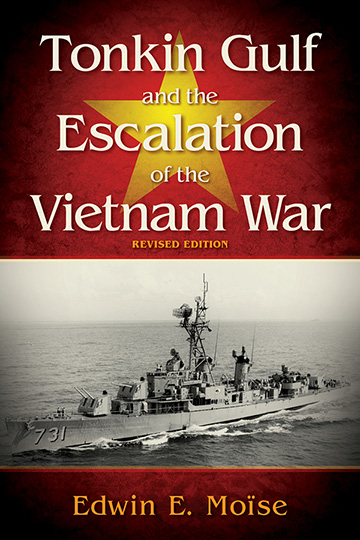   | [about](https://nsarchive.gwu.edu/about) | [documents](https://nsarchive.gwu.edu/virtual-reading-room) | [news](https://nsarchive.gwu.edu/postings/news) | [postings](https://nsarchive.gwu.edu/postings/all) | [FOIA](https://ns…
- [WEB] https://www.nsa.gov/portals/75/documents/news-features/declassified-documents/gulf-of-tonkin/articles/release-1/rel1_skunks_bogies.pdf [archived]
UNCLASSIFIEDffFOR Ol'l'ICIAL tl8! ONLY # Distribution ## Cryptologic Quarterly is published four times a year by the Center for Cryptologic History, NSA. The publication is designed as a working aid and is not sub-ject to receipt, control, or accountability. Distribution is made …
CROSS-REFERENCE
- ← SUPPORTS Tonkin Gulf Resolution 1964: Congressional Speed, Political Pressure, and Contemporaneous Doubt — NSA declassified intercepts directly bear on whether intelligence presented to Congress was complete and accurate.
- ← SHARES-EVENT North Vietnamese Military Archives on August 4, 1964 Gulf of Tonkin Patrol Boat Activity — This dossier investigates the same event and directly references the NSA declassified intercepts, expanding on what they documented.
- ← SHARES-EVENT Gulf of Tonkin Incident: Allegations of Intentional Destruction or Redaction of Sonar/Radar Tapes (August 4, 1964) — The alleged destruction or redaction of sonar/radar tapes relates to the broader intelligence context, including NSA intercepts, surrounding the disputed August 4, 1964, event.
- ← SUPPORTS Unreleased NSA Intercepts of North Vietnamese Communications (August 4-5, 1964) — This dossier directly asks about the potential existence of *unreleased* NSA intercepts, building upon the known declassified intercepts discussed in the target dossier.
- ← SUPPORTS LBJ/McNamara Briefings: Uncertainty on August 4 Gulf of Tonkin Attack — This investigation examines whether the declassified NSA intercepts showing ambiguity were formally briefed to decision-makers.
- ← SHARES-EVENT Tonkin Gulf Resolution Text: Pre-August 4, 1964 Executive Branch Drafting — The drafting of the resolution is linked to the August 4, 1964, event, which NSA intercepts later provided context for.
- ← SUPPORTS NSA Intelligence on Gulf of Tonkin Attack: Real-Time vs. Retrospective Analysis — The NSA's retrospective analysis heavily relies on the declassified SIGINT intercepts from August 4, 1964.
- ← PRECEDES Gulf of Tonkin Resolution: Executive Directives for Accelerated Passage — The NSA intercepts related to the August 4, 1964 incident are central to understanding the basis for the Gulf of Tonkin Resolution.
- ← CONTRADICTS Gulf of Tonkin Resolution Timeline: White House and NSC Discussions August 1964 — This dossier's claim about the absence of a second attack on August 4, 1964, directly aligns with findings in the NSA declassified intercepts dossier.
- ← SHARES-EVENT Vietnamese Ministry of Foreign Affairs Access Criteria for Foreign Researchers — This dossier investigates the potential for foreign researchers to access Vietnamese records related to the Gulf of Tonkin, a topic deeply linked to NSA intercepts.
- ← SUPPORTS Gulf of Tonkin Incident: Meteorological and Sea State Conditions on August 4, 1964 — The debunking of the second attack based on NSA documents is consistent with the internal doubts reported by the USS Maddox regarding the contacts on August 4, 1964.
- ← SHARES-EVENT Soviet Bloc Memoirs and North Vietnamese Communications (August 1964) — The inquiry into Soviet access to North Vietnamese communications is directly relevant to understanding intelligence surrounding the contested August 4, 1964, event.
- ← SHARES-EVENT CIA and NSA Analyst Doubts Regarding Second Gulf of Tonkin Incident — The alleged misinterpretation of SIGINT is central to both the analyst doubts and the broader discussion of the August 4 intercepts.
- ← CONTRADICTS USS Maddox Crew Testimony on Gulf of Tonkin Recordings (1964) — Crew testimonies claiming no attack on August 4th would contradict initial reports that were later bolstered by misinterpretations of NSA intercepts.
- ← SUPPORTS NSA and Navy Historical Reviews of Gulf of Tonkin Radar and Sonar Tapes (1964-2005) — The NSA historical review explicitly details how SIGINT (intercepts) were distorted in relation to the August 4, 1964, incident.
- ← SHARES-EVENT USS Turner Joy Radar Returns: August 4, 1964 Gulf of Tonkin Incident — The radar returns are a critical piece of evidence alongside NSA intercepts in evaluating the August 4, 1964, Gulf of Tonkin incident.
- ← SHARES-EVENT North Vietnamese Accounts of August 4, 1964 Gulf of Tonkin Incident — This dossier seeks to complement NSA declassified intercepts with North Vietnamese primary accounts regarding the August 4, 1964, event.
- ← SHARES-EVENT Gulf of Tonkin Incident: Corroborating Sonar Logs from Other Vessels (August 4, 1964) — The NSA intercepts dossier deals with the same August 4, 1964 event, providing intelligence context to the sonar claims.
- ← SHARES-EVENT Congressional Questioning of Second Gulf of Tonkin Incident Before Resolution Vote — The NSA intercepts are central to the debate over the veracity of the August 4th incident, which congressmen would have been reacting to.
- ← SHARES-EVENT Executive Branch Discussions on Vietnam Resolution Pre-Gulf of Tonkin (1964) — Both dossiers relate to the August 1964 Gulf of Tonkin incident and the veracity of the second attack claim.